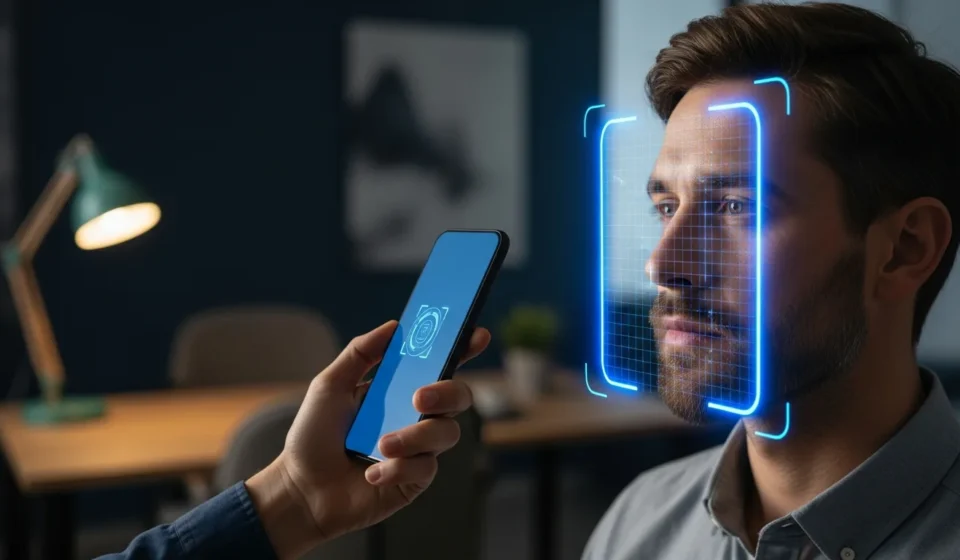
📸 Image generated using AI

The Escalation of Deepfake Fraud in 2026
A fraudster no longer needs a physical ID to hijack a bank account. He only needs a few minutes of audio or a high-resolution video of his target to create a synthetic clone. By 2026, deepfake technology has reached a point where human eyes—and even standard digital filters—can no longer distinguish between a real person and an AI-generated avatar. This shift has forced financial institutions to rethink their entire approach to identity verification.
The threat is no longer theoretical. He might receive a video call from his CFO authorizing a massive wire transfer, only to realize later that the face and voice were entirely synthetic. As he navigates the complexities of modern fintech cybersecurity threats, the need for real-time liveness detection becomes undeniable. Static biometrics are dead; the future lies in dynamic, multi-modal verification.
Why Traditional Biometrics Are No Longer Enough
For years, facial recognition and fingerprint scanning were the gold standards. However, these methods often rely on 2D data points that a sophisticated AI model can easily replicate. If a hacker obtains a high-quality photo of a user, he can use generative adversarial networks (GANs) to create a moving, speaking model that bypasses basic “blink tests.”
- Static Image Spoofing: High-resolution photos used to trick 2D cameras.
- Replay Attacks: Using a pre-recorded video of the user to satisfy a prompt.
- Synthetic Voice Injection: Using AI to mimic a user’s vocal patterns during phone-based authentication.
To counter this, fraud detection deepfake prevention biometrics must move toward 3D depth sensing and infrared mapping. These technologies ensure that the person on the other side of the screen is a living, breathing human being, not a projection on a flat surface.
Advanced Liveness Detection: The First Line of Defense
Liveness detection is the process of verifying that a biometric sample is submitted by a real person present at the point of capture. In 2026, this has evolved into two distinct categories: active and passive.
Active Liveness Detection
This requires the user to perform a specific action, such as turning his head, smiling, or reading a randomized string of numbers. While effective, it can create friction in the user experience. If he has to jump through too many hoops, he might abandon the transaction entirely.
Passive Liveness Detection
This is the preferred method for modern fintech. It works in the background, analyzing skin texture, light reflection, and micro-expressions without requiring the user to do anything. Advanced algorithms can detect the “shimmer” or pixel inconsistencies that occur when a deepfake is overlaid on a real video stream. Platforms like Adyen have already begun implementing sophisticated revenue protection and fraud detection mechanisms to stay ahead of these synthetic identities.
The Rise of Behavioral Biometrics
If a fraudster manages to bypass facial recognition, behavioral biometrics acts as a secondary safety net. This technology doesn’t look at who the user is, but rather how he behaves. Every individual has a unique digital fingerprint in how he interacts with his devices.
- Keystroke Dynamics: The rhythm and speed at which he types.
- Mouse Movements: The specific curves and acceleration of his cursor.
- Gait and Pressure: How he holds his phone and the pressure he applies to the screen.
If a user suddenly starts navigating a banking app with the mechanical precision of a bot or the erratic patterns of a stranger, the system triggers an immediate freeze. This continuous authentication ensures that even if he is logged in, his account remains protected from session hijacking.
Integrating AI to Fight AI
The only way to defeat a deepfake is with a more powerful AI. Machine learning models are now trained on millions of deepfake examples to recognize the subtle artifacts left behind by generative software. These models look for blood flow changes in the face (photoplethysmography) and inconsistencies in how light hits the eyes—details that even the most advanced deepfakes struggle to replicate perfectly.
By combining fraud detection deepfake prevention biometrics with real-time risk scoring, banks can create a fortress around their users. He can rest easy knowing that his identity is verified not just by a password, but by the very essence of his physical and behavioral presence.
Frequently Asked Questions
Can deepfakes bypass modern fingerprint scanners?
No, deepfakes are primarily a threat to visual and auditory biometrics. Fingerprint scanners rely on physical ridges or ultrasonic 3D mapping, which cannot be spoofed by a digital video or audio file.
What is the most secure form of biometrics in 2026?
Multi-modal biometrics, which combine facial recognition, iris scanning, and behavioral analysis, are considered the most secure. Relying on a single factor is no longer sufficient to stop professional fraudsters.
How does liveness detection identify a deepfake?
It looks for “non-human” traits, such as unnatural eye blinking, lack of pulse-related skin color changes, and microscopic inconsistencies in how shadows move across the face during a live video feed.