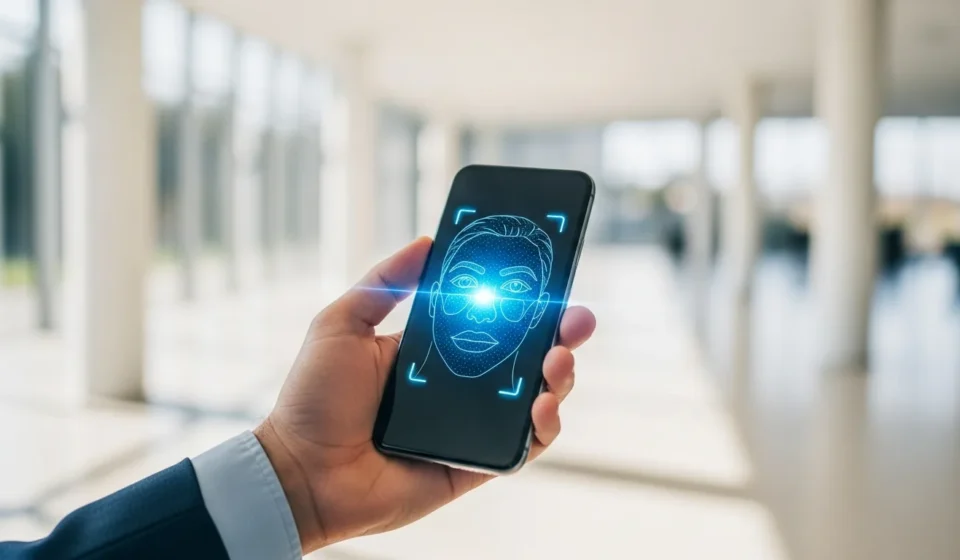
📸 Image generated using AI

The High-Stakes Race for Instant Onboarding
Neobanks have a massive problem: the very speed that attracts customers also attracts sophisticated criminals. If a user can open an account in three minutes, a fraudster thinks he can do it in two. In 2026, digital identity verification for neobanks is no longer just about scanning a driver’s license; it is a high-stakes game of cat and mouse involving biometric liveness, device fingerprinting, and real-time data orchestration.
For a neobank founder, the goal is simple but difficult to execute. He needs to ensure that the person on the other side of the screen is who he claims to be, without making that person jump through so many hoops that he abandons the app. A robust strategy for fintech cybersecurity and modern threats ensures that a neobank doesn’t just grow fast, but grows safely against evolving identity theft tactics.
Biometric Liveness: Defeating the Deepfake
Static photos are dead. In an era where AI can generate a convincing video of anyone, neobanks have shifted to active and passive liveness detection. When a user signs up, the app might ask him to perform a specific action—like nodding his head or following a light on the screen with his eyes. This proves he is a living, breathing human present at the moment of application.
- Active Liveness: Requires the user to respond to a prompt (e.g., “Turn your head to the left”).
- Passive Liveness: Uses background algorithms to detect skin texture, depth, and micro-movements without the user even knowing he is being analyzed.
- 3D Face Mapping: Compares the depth of facial features against the 2D image on a government ID to prevent “presentation attacks” using masks or high-res screens.
NFC and Chip-Based Verification
The most secure neobanks now bypass the camera entirely when possible. By using the NFC (Near Field Communication) reader in a user’s smartphone, the app can read the encrypted data directly from the chip in his biometric passport or ID card. This method is nearly impossible to spoof because the data is signed by the issuing government.
When a developer builds these features, he often relies on composable banking infrastructure to integrate specialized IDV (Identity Verification) providers. This modular approach allows the bank to update its verification stack the moment a new security flaw is discovered in older methods.
Behavioral Analytics: The Silent Guardian
Identity verification doesn’t end once the account is open. Neobanks now use behavioral biometrics to ensure the account holder remains the same person. The system monitors how he holds his phone, his typing rhythm, and even his typical swipe patterns. If a fraudster gains access to his device, the sudden change in interaction style triggers an immediate step-up authentication challenge.
This layer of security is invisible to the legitimate user, maintaining the “frictionless” experience that neobanks promise. It allows the bank to protect his funds without requiring him to enter a password every time he checks his balance.
The Regulatory Burden of KYC and AML
Regulators in 2026 have no patience for “move fast and break things” when it comes to money laundering. Neobanks must balance their digital-first nature with strict Know Your Customer (KYC) and Anti-Money Laundering (AML) laws. This involves cross-referencing the user’s identity against global watchlists, PEP (Politically Exposed Persons) lists, and adverse media in real-time.
If a user’s name appears on a sanctions list, the system must automatically freeze the onboarding process. The challenge for the neobank is doing this in milliseconds so the honest user never feels the lag.
Frequently Asked Questions
How long does digital identity verification take in 2026?
For most neobanks, the automated process takes between 30 and 90 seconds. If the system flags a discrepancy, a manual review by a compliance officer might take a few hours, though this is becoming increasingly rare as AI accuracy improves.
Can a neobank account be opened with a stolen ID?
It is extremely difficult. Modern liveness detection and device fingerprinting make it nearly impossible for a fraudster to use a stolen physical ID unless he also has a high-quality 3D mask or a deepfake capable of bypassing biometric sensors, both of which are heavily defended against.
Is my biometric data safe with a neobank?
Most neobanks do not store your actual biometric image. Instead, they convert your facial features into a mathematical hash. Even if the bank’s database were breached, the hacker would only find strings of numbers that cannot be reversed back into your face.